Saddle of Venison or Venison Entrecôte with Spätzli, Red Cabbage, and Game Gravy
Saddle of Venison or Venison Entrecôte – A Classic Game Dish Served with Spätzli, Red Cabbage, and Chestnuts
Tender game meat, golden-yellow butter spaetzle, aromatic red cabbage, and glazed chestnuts—a classic of Swiss fall and winter cuisine.
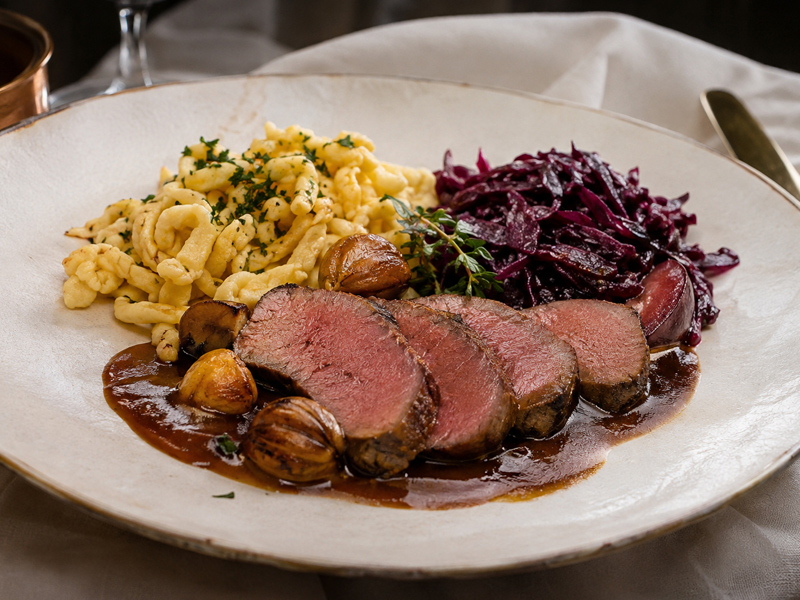
Whether it's Swiss saddle of venison on the bone or venison entrecôte, both cuts impress with their delicate gamey flavor and, when prepared properly, can be served wonderfully pink and juicy.
It doesn't take hours of preparation. With good spätzli, prepared red cabbage, and a hearty game gravy, you can create a festive game dish where the meat is clearly the star of the show.
Ingredients for 2 people
For game meat
- 1 kg Swiss venison saddle on the bone
- Alternatively, 350–450 g venison entrecôte
- 1 tablespoon of cooking butter or high-heat oil
- 30 g butter
- 2 sprigs of thyme
- 1 sprig of rosemary
- 2 cloves of garlic
- Salt
- Freshly ground black pepper
For the side dishes
- 300 g fresh spätzli
- 300 g prepared red cabbage
- 120–150 g pre-cooked, peeled chestnuts
- 30 g butter for the spätzli
- 15 g butter for the chestnuts
- 1 teaspoon sugar
- 50 ml water or vegetable broth
- Salt, pepper, and a little nutmeg
For the sauce
- 150–200 ml of rich game gravy
How to Cook Saddle of Venison or Venison Entrecôte Properly
1. Prepare the game meat and sear it
Pat the saddle of venison on the bone or the venison entrecôte dry with paper towels and season generously on all sides with salt and freshly ground pepper.
Heat a large, heavy skillet or roasting pan over high heat and sear the meat on all sides with a little butter or oil until a nice golden-brown crust forms.
Next, remove the meat from the pan and let it finish cooking gently in an oven preheated to 100 °C until it reaches just below the desired final internal temperature of 56–58 °C.
When cooking a saddle of venison, insert the meat thermometer into the thickest part of the loin muscle without touching the bone.
Since the venison loin is cooked on the bone, it generally takes longer to cook than a boneless venison entrecôte. Therefore, the key factor is always the internal temperature, not a fixed cooking time.
2. Season with butter, rosemary, and thyme
Just before serving, heat the pan again.
Add the butter, rosemary, thyme, and the lightly crushed garlic cloves, and let the butter foam up.
Toss the game meat briefly in the flavored butter once more, and spoon the melted herb butter over it repeatedly.
Then let the meat rest on a cutting board for 3–5 minutes.
For the venison loin, carefully remove the two loin fillets from the bone and cut them across the grain into nice medallions.
Cut the venison entrecôte into slices across the grain as well.
3. Sauté the spätzli in butter until golden brown
Melt the butter in a large skillet over medium heat.
Add the spätzli and sauté them slowly until they turn golden brown. Turn them occasionally so they become slightly crispy on the outside and stay nice and soft on the inside.
Season to taste with salt, freshly ground pepper, and a pinch of nutmeg.
4. Gently heat the red cabbage
Slowly heat the prepared red cabbage in a pot over low to medium heat.
If necessary, add a small sip of water.
If you like, you can enhance the red cabbage with a little grated apple, a splash of apple juice, or a few cranberries.
5. Glaze the chestnuts
Melt the butter in a small pan and let the sugar caramelize slightly.
Add the pre-cooked chestnuts and gently toss them in the mixture.
Deglaze with a little water or vegetable broth and let it reduce over medium heat until the chestnuts are nice and shiny and coated with a thin glaze.
6. Heat the game gravy and serve
Slowly heat the game gravy in a small saucepan. If it has already reduced to the desired consistency, there is no need to reduce it further.
Arrange the golden-yellow butter spaetzle and the red cabbage on preheated plates.
Arrange the sliced medallions of saddle of venison or the slices of venison entrecôte next to them, scatter the glazed chestnuts over the dish, and finish with the hot game jus.
Garnish with a little fresh thyme, if desired.
The Perfect Internal Temperature for Saddle of Venison and Venison Entrecôte
Game meat is naturally very low in fat and should therefore be cooked very gently. Controlling the internal temperature is crucial to ensuring that the meat remains tender and juicy.
| Cooking Level | Core temperature |
|---|---|
| Rare | 48–50 °C |
| Medium Rare | 52–54 °C |
| Medium | 55–58 °C |
| Fully cooked | at or above approximately 65 °C |
Our recommendation: For game meat cooked to medium-rare, we recommend a final core temperature of 56–58 °C, provided the meat is suitable and has been processed under hygienic conditions.
During the final step of browning in hot butter and while the meat is resting, the core temperature may still rise slightly. Therefore, remove the meat from the oven a little earlier than usual.
Note: The pink cooking levels do not indicate that the meat is safely cooked through. Game meat may contain pathogens or parasites. To minimize the risk, game meat should be cooked thoroughly; this is especially important for people with sensitive digestive systems.
Saddle of venison or venison entrecôte—what's the difference?
Both cuts of meat are excellent choices for this classic game dish.
Saddle of Venison on the Bone
The saddle of venison is one of the finest cuts of venison. The meat has a particularly fine grain, is tender, and has a subtle, elegant gamey flavor.
We recommend cooking the saddle of venison on the bone, as the bone partially protects the meat from direct heat during cooking and helps create a flavorful result.
A bone-in saddle of venison weighing about 1 kg is suitable for two people. Since a significant portion of the weight consists of bone and trimmings, the actual amount of meat is considerably less.
Venison Entrecôte
Venison entrecôte has a slightly stronger natural flavor and a firmer texture than venison loin.
It's perfect for quick-frying and develops particularly lovely roasted flavors when seared at a high temperature.
Our tip: If you prefer a particularly delicate and elegant flavor, choose saddle of venison. If you prefer a slightly more intense gamey flavor, go for venison entrecôte.
What side dishes go well with saddle of venison and venison entrecôte?
Classic fall and winter side dishes go especially well with medium-rare game.
Butterspätzli: Fried until golden brown and slightly crispy—the classic side dish for game.
Red cabbage: Its subtle sweetness and tartness pair wonderfully with the rich game gravy.
Glazed chestnuts: Add nutty, slightly sweet flavors to the dish.
Alternatively, mashed potatoes, celery purée, Brussels sprouts, or potato noodles also go wonderfully with this dish.
Our Tip
The most important ingredient in this dish is the meat.
A high-quality Swiss saddle of venison on the bone or a nice venison entrecôte doesn't need much more than a crispy crust, the right internal temperature, and a little butter with fresh herbs.
When it comes to side dishes, however, keep it simple. Good, pre-made spätzli, red cabbage, and roasted chestnuts save time without compromising on flavor.
This way, with minimal effort, you can create a classic game dish that will impress even at a festive dinner.
Frequently Asked Questions About Saddle of Venison and Venison Entrecôte
How much saddle of venison on the bone do you need per person?
For two people, we recommend about 1 kg of venison loin on the bone. Since a significant portion of the weight consists of bone and trimmings, the actual amount of meat is considerably less.
What should the internal temperature of a saddle of venison be?
For a medium-rare saddle of venison, we recommend a final core temperature of 52–54 °C, provided the meat is of suitable quality. This ensures the meat remains tender and juicy. However, this level of doneness does not mean the meat is fully cooked through.
How long should a rack of venison on the bone cook in the oven?
That depends on the size and thickness of the venison loin. At an oven temperature of 80 °C, the cooking time can vary significantly. The most reliable method is to use a meat thermometer, which should be inserted into the thickest part of the meat without touching the bone.
Should you prepare venison loin with or without the bone?
Both methods work. We recommend cooking the meat on the bone, as the bone partially protects the meat from direct heat during cooking and helps produce a particularly flavorful result.
After cooking, carefully remove the meat from the bone and cut it into medallions.
Is venison healthy?
Venison is naturally low in fat, high in protein, and a good source of valuable nutrients.
Of particular interest are their high levels of high-quality protein, as well as iron, zinc, and vitamin B12. These nutrients are important for muscle growth, oxygen transport, and normal energy metabolism, among other things.
The exact nutritional composition depends on the animal, the cut of meat, and how it is prepared.
Is game meat a good source of protein?
Yes. Venison typically provides about 20–24 g of protein per 100 g of raw meat and is relatively low in fat.
This makes them an excellent choice for a protein-conscious diet.
Does game meat contain a lot of iron?
Game meat is a source of iron, including what is known as heme iron, which the human body generally absorbs more easily than plant-based iron.
Iron contributes to the normal formation of red blood cells and to the normal transport of oxygen in the body.
Can you cook venison entrecôte the same way you would a beef steak?
Yes. Venison entrecôte can be prepared much like a beef steak. Since game meat usually contains less fat, special attention should be paid to the internal temperature.
What sauce goes well with venison loin?
A hearty game gravy is the classic accompaniment. Red wine gravy, cranberry sauce, or a sauce made with juniper and game stock also pair very well.
Can I use store-bought spätzli and red cabbage?
Of course. Good, fresh spätzli can be sautéed in butter until golden brown. Prepared red cabbage can be gently reheated and seasoned to taste.
This leaves more time to cook the meat to perfection.
Can I prepare this dish?
Red cabbage, chestnuts, and game gravy can be prepared in advance and reheated before serving.
Game meat, on the other hand, should be prepared as fresh as possible.
Related Products from Das Fleisch
Swiss saddle of venison on the bone
Fine-grained, delicate, and with an elegant gamey aroma—ideal for special moments of indulgence.
Venison Entrecôte
Flavorous game meat, perfect for quick-frying and classic game dishes.
A classic that never fails to delight.
Tender Swiss saddle of venison on the bone or aromatic venison entrecôte, golden-yellow butter spaetzle, red cabbage, and a rich game gravy.
Discover our game specialties and bring a taste of Swiss fall cuisine to your plate.